
How people actually use AI
Yuri Gizatullin explains why ChatGPT is more often used as a polite search engine than as a business accelerator, and where the real effect gets lost.

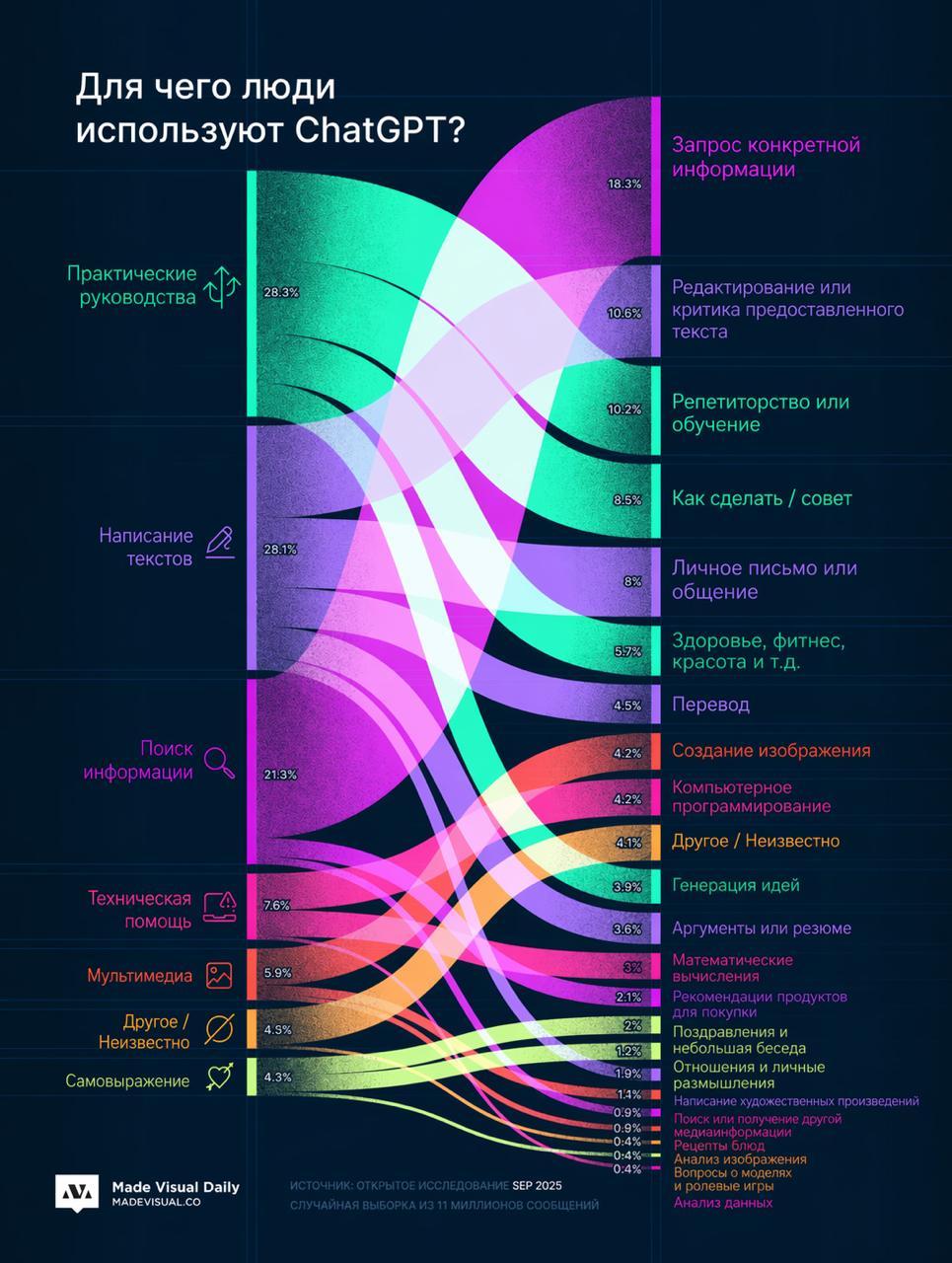
I recently looked at the results of a large study by OpenAI, NBER and Duke University on how people really use ChatGPT, and the numbers, honestly, surprised me. An analysis of 1.5 million conversations showed that:
29% of requests are practical advice and learning,
27% are writing and editing texts,
24% are searching for information,
and only 4.2% are programming and math.
That is, most people use the most powerful technology in human history as a very polite search engine.
29% of requests are practical advice and learning,
27% are writing and editing texts,
24% are searching for information,
and only 4.2% are programming and math.
That is, most people use the most powerful technology in human history as a very polite search engine.
And as a familiar crutch
I see two things in this at once. First, people do not yet understand how deeply AI can be built into work and life. Second, most use it to speed up familiar actions: write a letter, clarify a thought, find what you could have found in a search anyway. This is convenient, but it is not yet transformation.
That is exactly why it seems important to me to distinguish “playing around with ChatGPT” from really embedding AI in processes. The first scenario gives a quick feeling of usefulness; the second changes the economics, the speed of decisions and the scale of the possible result. The difference between them is roughly that between a toy car and a Formula 1 car.
Where AI gives a leap
I believe AI should be used not just to praise you or answer questions but for more serious tasks. It can calculate product economics, look for weak spots in a business, produce analytics quickly, help you make decisions faster than competitors and even launch an MVP without a big team or investment. That is the real effect of the technology: not to replace search but to speed up the creation of value.
When a company uses AI only as a “smart chat”, it gets a local gain in convenience. But when AI is built into analytics, product, sales and operations, it starts to affect revenue. For me that is the border between curiosity and real adoption.
Why business underestimates AI
Many companies still think AI is an expensive toy for enthusiasts or marketers. But research and practice show the opposite: AI is already used on a mass scale for decisions, not only for creativity, and this is becoming economically significant. The problem is that business often limits itself to a familiar scenario of use, although the tool itself is capable of much more.
I wrote the book “ChatGPT for Business” (in Russian) precisely to show that AI should help you earn, not just be a conversation partner who is always right and always polite. If you use it as a full working tool, the effect becomes many times stronger.
What to do right now
I would advise starting with a simple question: do you use AI as an assistant or as a system for strengthening your business? If the answer is only an assistant, the potential is almost untapped. And if AI already affects product, analytics, sales and the speed of decisions, you are on the right track.
One more important conclusion: the faster a company learns to use AI not to “play around” but for profit, the higher its chance of overtaking those who have so far limited themselves to looking up recipes and retelling thoughts.


