
People are no longer needed: mass layoffs and the labor market in autumn 2025
Tiqum founder Yuri Gizatullin explained why the rise of AI and automation is changing the structure of employment and why companies should move to compact teams

Autumn 2025 marked a new turning point in the labor market: for the first time in several years the number of résumés in Russia exceeded the number of vacancies.
Where employers used to compete for specialists, the situation has now changed: the market is becoming an employer's market.
Where employers used to compete for specialists, the situation has now changed: the market is becoming an employer's market.
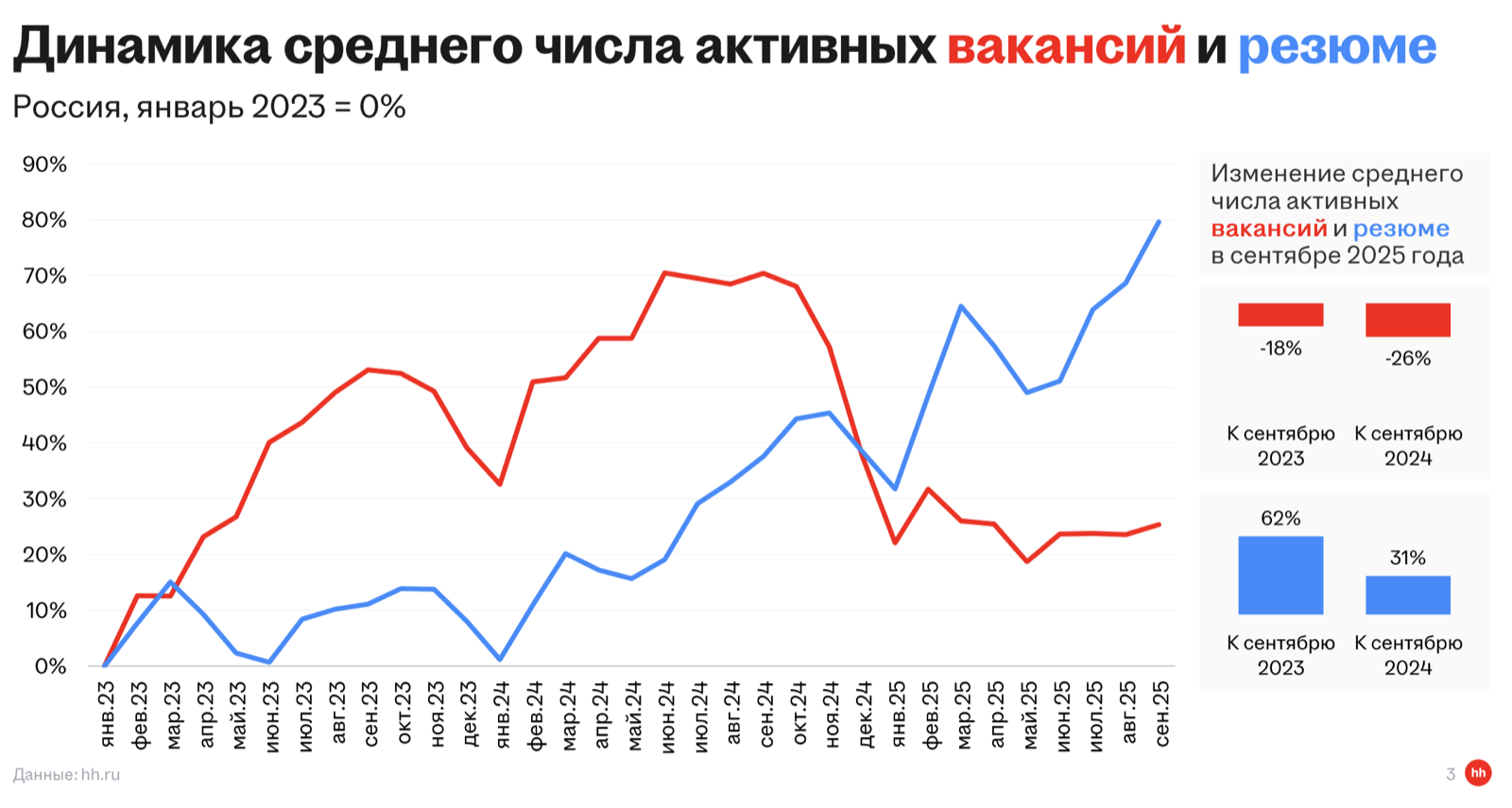
According to HeadHunter, by September 2025 the number of vacancies had fallen by 26% compared with the previous year, while the number of résumés had grown by 31%.
The decline is especially visible in IT: there are about 20% fewer vacancies for developers than in the first half of 2024.
The reasons for the shift are obvious
In recent years companies actively built up their IT teams to speed up digital transformation, but now most processes have already been automated.
The irony of the situation is that the very specialists who created solutions for optimizing labor have themselves come under the influence of the same tools.
The layoffs reported by the largest companies are only part of a natural cycle.
According to industry sources, a number of organizations have announced staff optimization in connection with the introduction of artificial intelligence.
This is not a local trend but a transition to a new model: AI and platform solutions reduce the need for a large number of “operational hands”.
What this means for business
We have entered a period when efficiency is determined not by the number of employees but by the speed of adaptation.
Companies that manage to rebuild their processes and bet on automation will be able to stay competitive at lower costs.
What matters is not just cutting expenses but building a new management architecture, from processes to performance indicators.
What this means for specialists
The market expects not a reduction in employment but a redistribution of competencies.
Demand is shifting from “executors” to those who can manage digital tools and build business processes around AI.
Skills with GPT models, low-code and analytics are becoming as basic a requirement as knowing Excel 10 years ago.
Machines do not take jobs away; they are lost by those who have not learned to work with them.
What this means for the market
The number of employees is no longer a measure of a company's strength.
Today what is valued is the ability to scale without increasing staff and to achieve the same results with fewer resources.
The appearance of “micro-companies” with revenue and valuation comparable to the big players is a matter of the next few years.
Such projects are already emerging on the global market: teams of 2–3 people create products with billion-dollar valuations using AI, the cloud and automated pipelines.
We are entering an era in which it is not the human who works for the system but the system that works for the human.
This is not a crisis but a natural transition: from growth through expansion to growth through efficiency.


