
How an entrepreneur can work with AI: three tips from personal experience
Yuri Gizatullin on replacing part of a team with AI agents, choosing models for tasks and moving from individual prompts to rebuilding business processes.
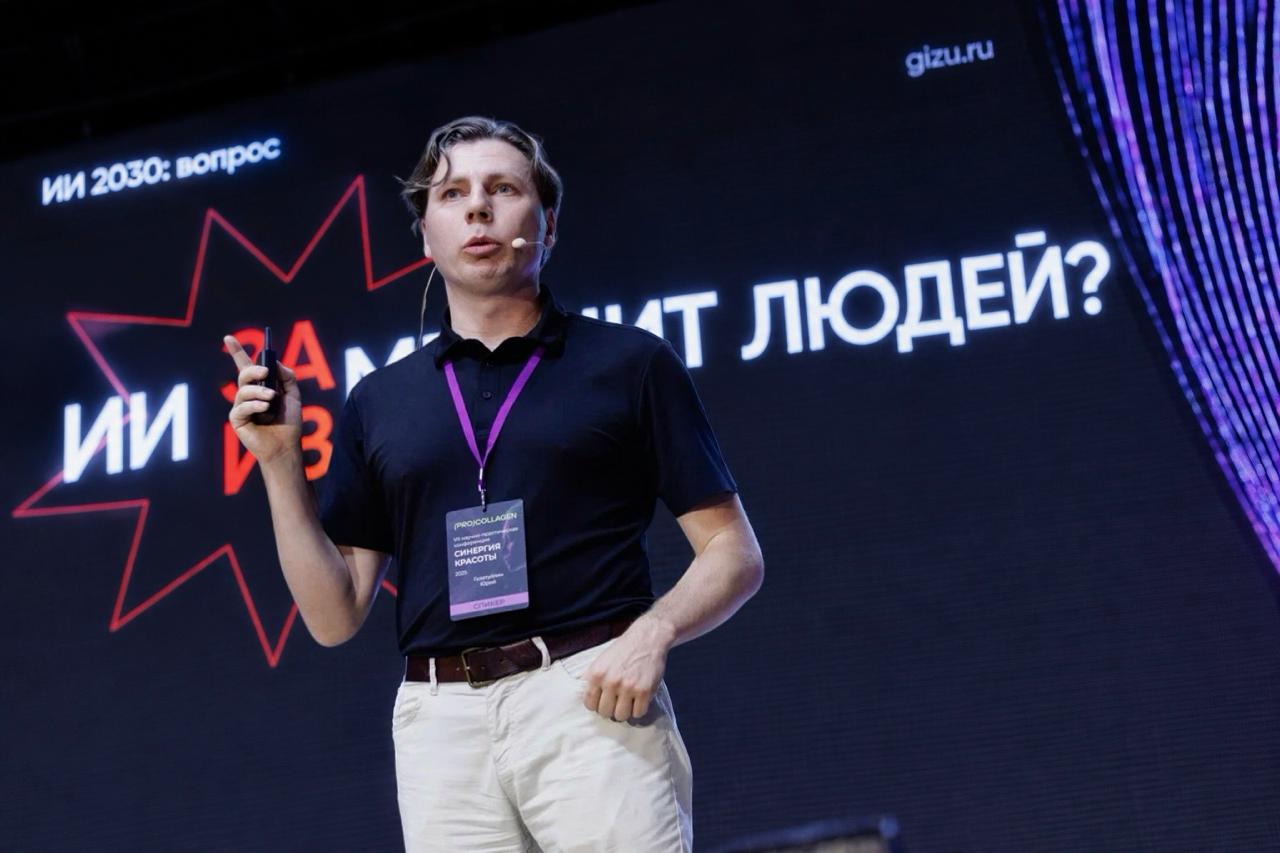
From the stage I used to say that artificial intelligence will not replace people. Meanwhile, in my own projects I have already replaced a copywriter, four designers who worked on interfaces and user experience, and six programmers with AI agents. So did I deceive the audience? Rather, I put too briefly a thought that today has to be explained much more precisely.
The familiar division of work between specialists is changing: some of the tasks that used to require separate people can now be done with the help of AI. So the promise that the technology will replace no one creates a false sense of safety. I link the ability to keep your value to the ability to use AI as an exoskeleton: a tool that extends your competencies and lets you answer for a bigger result.
An entrepreneur should be among the first to master this approach. As long as a leader sees AI tools as a toy for employees, it is hard for them to see which processes can already be organized differently. I am now developing my own concept of applying AI in business, but three principles from everyday practice I can formulate today.
Tip 1. Match the AI to the task
Tying all of a company’s tasks to one service is convenient, but the habit limits your options. Writing code, preparing an image, finding fresh data and working through a complex management question require different tools and different ways of checking. So I assemble a working set in which every service has its own role.
Claude is my main tool for code, interface design and building agents. I use it where I need to take a complex task apart, hold the logic of the solution and go through several stages in sequence. In my workflow it has taken on a large share of the work of programmers and interface designers, while I handle image generation by other means.
ChatGPT has become my everyday tool: texts, editing, images, code and tasks with several consecutive steps. With its help I cover the work for which I used to bring in a copywriter, an editor and an image designer. This is my way of distributing tasks, not a claim that one service is always better than the others in each of these areas.
Perplexity I use above all for research, for finding current facts and figures, and also for generating images. In my work it has taken on the tasks of an analyst. The ability to choose different models inside the service is convenient, but the presence of links in an answer does not remove the need to check: it is important to open the source and make sure it really supports the conclusion.
In reserve I keep Gemini for tasks with a large amount of context, Kimi and Qwen, as well as the Russian GigaChat and Alice. Such a reserve helps me depend less on one provider: the availability of Western services, the terms of use and the feature set can change. At the same time a specific tool should be judged on your own tasks, because the familiar balance of power between models does not stay constant either.
Separately, I recommend saving significant AI chats and working materials in folders in Markdown format: plain text files with the .md extension. It is useful to record the original task, the constraints, the decisions made and the final documents. This makes it easier to carry context between services, although it does not by itself transfer their built-in memory, settings and integrations.
Tip 2. Build a dialogue instead of waiting for a perfect answer
The prompt “Come up with a step-by-step strategy for a billion” looks good in a short video but says almost nothing about a real business. The model does not know your economics, your team’s constraints, your market position or your acceptable risk until you describe them. The less specific detail AI gets, the more gaps it fills with general recommendations.
I suggest starting with the problem: what exactly is not working, what data you already have, what you need to achieve and which conditions must not be broken. Then it is useful to ask the model to propose criteria for evaluating a solution. That lets you first agree on what counts as a good result and only then compare options.
I would treat the first answer as the start of the work. Obvious ideas usually come quickly, while more interesting ones require clarification, alternatives and testing of assumptions. Instead of asking to “make it better”, it is more useful to explain what does not fit: too expensive, ignores the customer’s specifics, requires unavailable resources or repeats an approach already tried.
Another important role for AI is that of opponent. Ask it to find the weak points in your conclusion, offer an alternative explanation and list the circumstances in which the decision will not work. Then you can pass the result to another model for an additional assessment, remembering that different services can also repeat the same mistake.
Such work should end with a test in the market and in the company’s practice. A convincing text is not the same as a working strategy, and the agreement of several models does not replace a conversation with a customer, a calculation of the economics or an experiment. AI helps you prepare and examine a hypothesis faster; confirming its value still requires real data.
Tip 3. Rebuild the company around the new possibilities
I believe an entrepreneur’s goal is gradually to make AI part of how the company is built. As long as it is used only for individual texts or presentations, what changes is the speed of specific operations. A more significant effect appears when the whole process is reconsidered: how information arrives, who analyzes it, where the decision is made and what action the work ends with.
This applies to procurement, logistics, sales, marketing and development. Start with a clear task where the result can be seen, and then widen the use. If you simply add an AI tool to the old approval procedure, the company risks getting one more tool while keeping all the old delays.
For the entrepreneur personally, the value of AI also lies in being able to discuss hypotheses without being left alone with them. You can quickly formulate a thought, get objections and see which questions have not been worked through yet. I see such a dialogue as a way to keep moving from reflection to testing a decision.
This observation has an interesting research context. A study involving a Harvard Business School researcher showed that talking to an AI companion can reduce the subjective feeling of loneliness for a short time, with the sense of having been heard playing an important role. However, the study is about AI companions, not about the quality of entrepreneurial decisions: the conclusion about the speed of testing business hypotheses is my own practical reasoning.
An entrepreneur needs an AI exoskeleton too
The main shift begins when people stop seeing AI as an oracle obliged to give the right answer on the first prompt. A working approach requires context, several suitable tools, a consistent dialogue and checking of the result. It is from these elements that a process is formed that can be repeated and improved.
My experience of replacing a copywriter, four designers and six programmers does not mean that any business can mechanically repeat such a rebuild. It shows how much the boundaries of the tasks a person with AI can handle are shifting. So it is important for an owner to understand the tools’ capabilities personally before deciding how the team should change.
I no longer suggest reassuring yourself with the phrase “AI will not replace people”. It is already replacing work that used to require separate specialists, and this process will continue. For an entrepreneur the sensible strategy is to master the new ways of working and build a company that knows how to use them.


